

SMEs also deserve a well-thought-out office
09/07/2026
Many SME owners still feel that a professional office concept is mainly something for big companies. For organisations with multiple floors, large project teams, and impressive budgets. But not for “a smaller office like ours”.
That perception is alive and well, and it’s understandable. Especially since terms like ‘customisation’ or ‘comprehensive design’ are often automatically associated with high costs and complex processes. But that image is wrong.
After all, a well-thought-out working environment makes just as much difference in a team of ten as it does in an organisation of two hundred. Sometimes even more because the impact can be seen more quickly since everyone uses the space intensively, and because small changes are immediately felt in the daily work.
Strategic investment
At Pami, we believe that a working environment is not a luxury but a strategic tool: a place that supports people in what they do, every day. Regardless of the size of the company or the available budget.
That’s why Pami always starts from the same conviction: the expertise that works for large organisations also works for SMEs. Only it’s translated differently. Not bigger or heavier, but more focused. Tailored to the scale of the team, the available space, and the working method.
Because whether you work with seven colleagues or dozens, every organisation benefits from a working environment that is deliberately designed to suit what needs to be done every day.
Recognisable questions
The questions that arise in the process are strikingly recognisable. How do we make people feel good at work? How do we make the best use of our space without sacrificing comfort? How do we address ergonomics practically? And how do we create calm and focus in an environment where consultation and activity alternate rapidly?
These are questions on the minds of business managers, HR managers, and employees involved in office design. This is precisely why SME projects at Pami also start from the same thought experiment as larger projects: what is happening in the workplace today, and what does this team need to function well? We start by listening, then translate those insights into a feasible layout and tailor each choice to daily use. That people-centred approach always forms the basis.
The reality of SME offices
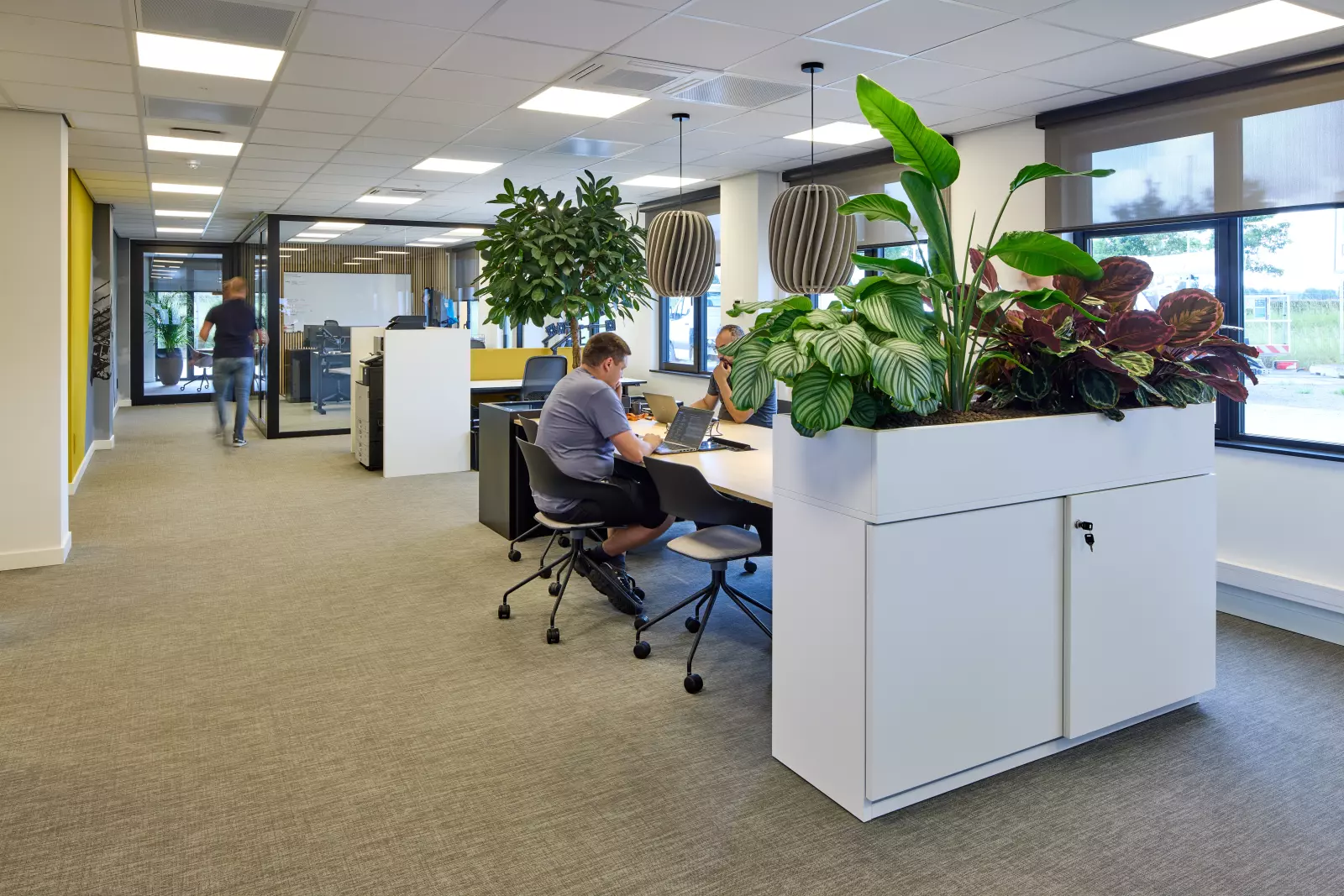
Smaller organisations often heavily use and share a space. Workstations, consultations, and phone calls intermingle. In that context, open offices are practical, and encourage communication, but sometimes make focusing difficult. Meeting rooms do exist, but do not always match the reality of short consultations or hybrid meetings.
Moreover, visual and mental turmoil soon ensues when spaces are not given a clear function. Furniture shifts, arrangements change, and space no longer naturally supports work.
On top of that, the corporate culture in SMEs is often tangible and personal. People really know each other; values are palpable. If the office does not reflect that identity, the working environment soon feels anonymous or disconnected from the company itself.
Just because teams are smaller and roles are more often intermingled, spaces often take on multiple functions. This doesn’t make the layout easier, just more strategic.
Smart design requires no major changes
Ultimately, every company wants the same thing: a working environment where people feel good and can work efficiently. So the difference is not in the ambition, but in the translation.
Whereas large organisations need several zones to organise everything, SMEs can often achieve the same effect with targeted adaptations. This need not automatically be customisation. Often, a smart combination of high-quality standard furniture is sufficient, complemented by targeted adjustments where it is really needed.
A meeting room can also support creative consultation. An open-plan workplace, with the right layout and acoustics, can still offer tranquillity. This is precisely why we don’t start from a standard solution or customisation for customisation’s sake, but from how an organisation really works and what the space needs to support that.
The big advantage of redesigning smaller offices?
You see and feel the effect immediately. A better layout, more focus, ergonomic comfort, or a space that better suits the team: the difference is immediately noticeable. And the expertise required for this is no different from that required for larger projects. Only the scale and approach are different.
Every big company was once an SME
Pami has been working on working environments of all shapes and sizes for more than 65 years, from local companies with a single office to international organisations. That experience means we can quickly see what a space needs, even when it’s compact.
We have a wide range of in-house, sustainably produced standard furniture that allows you to work efficiently and budget-consciously. Where necessary, we complement that with customisation, but always with a clear reason: better use of space, more ergonomics, or a better fit with the way the organisation works.
Thanks to our own production in Belgium, we can make those choices consciously. Here, sustainability is not in grandiose statements, but in materials that last. In circular principles and solutions that you don’t have to replace again after a few years. Thus, together, we build a working environment that not only works today, but also remains valuable in the long term.
Specifically, this means thinking along on layout and use, and making smart choices in furniture. Standard where possible, customisation where necessary. And building a working environment that evolves with the company step by step.
Growing in stages, at the customer’s pace
Nor does the trajectory have to be an all-or-nothing story. Certainly not for smaller companies. Office design can perfectly be done incrementally, depending on needs, budget, and growth plans.
Sometimes a targeted change is sufficient enough to then work forward in stages. Setting up some ergonomic workstations, for example. Or a reconfigured meeting room. This keeps each step manageable, financially clear, and tailored to what the SME concerned needs at the time.
But equally, several rooms or even the entire working environment can be taken care of at once. A brief moment of discomfort – both budgetary and organisationally – to then move full speed ahead again.
Every good office starts with listening
Every SME works differently. That is why a good office project always starts from the customer’s reality, in which we consistently put the employee at the centre. And in which we advise, support, and guide them throughout, from targeted optimisation to a comprehensive design.
Doubting whether your office currently suits the way you work? Then an initial conversation is often enlightening. No big project, no commitments, just a quick look at where small changes can make a big difference.
After all, every big company was once an SME.